
Transport Fever 3 oil platform guide: 1-4 crude oil output, the Tools booster, harbor docking, the 1950 unlock and the 4-to-2 refinery chain.
Transport Fever 3 Oil Platform Guide: How Offshore Crude Oil Works
Quick answer: the Oil Platform is a raw industry that produces between 1 and 4 units of Crude Oil, works in every climate, takes Tools as a booster cargo and only becomes available from 1950, once helicopters can reach offshore helipads. You plant it on the water, connect a harbor landing area on the nearest coast, and run liquid-capable ships to an Oil Refinery, where 4 Crude Oil turns into 2 Fuel, 1 Fertilizer and 4 Chemicals.
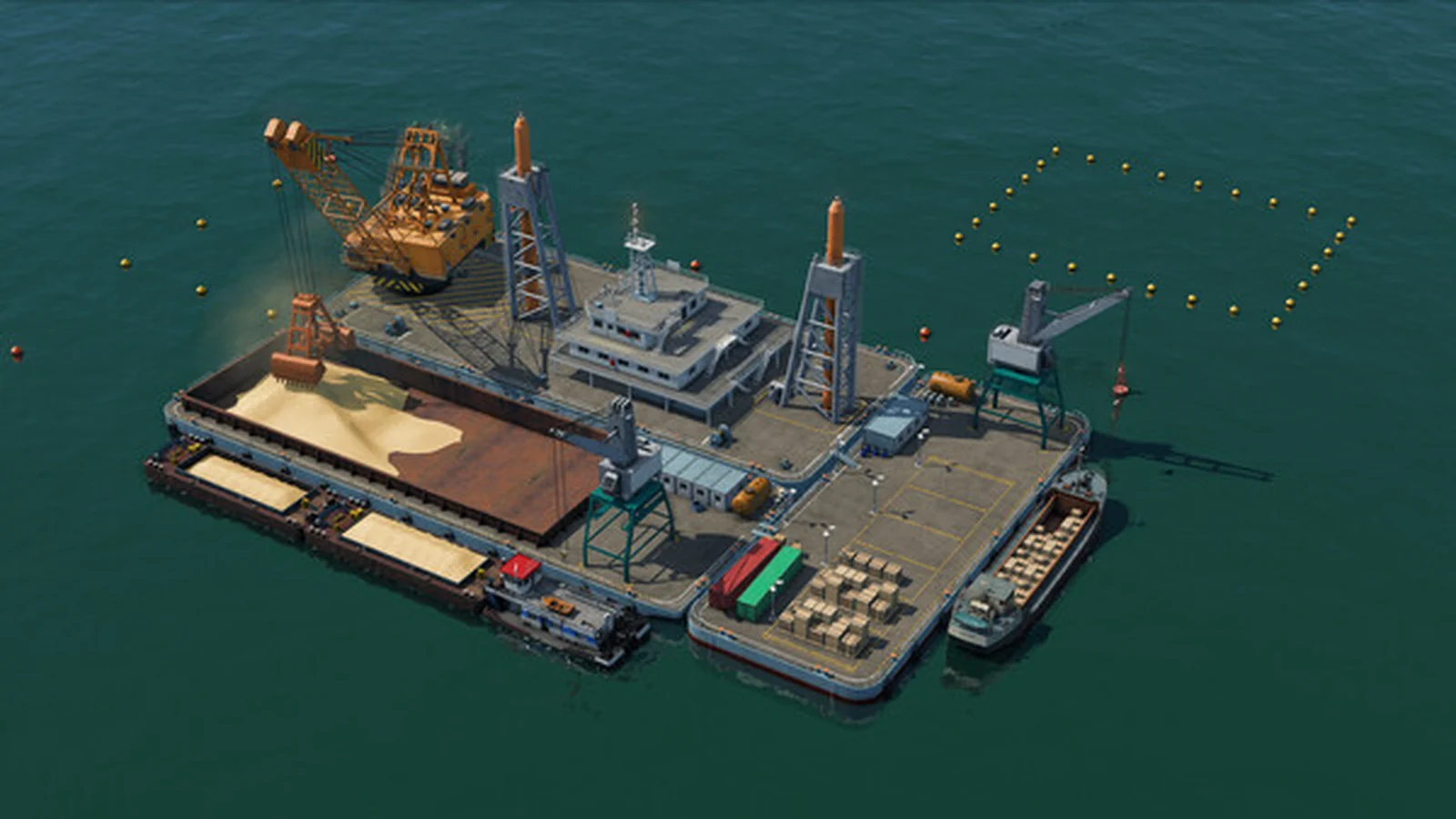
What the Oil Platform actually produces
The in-game industry list is the only reliable specification, because the platform never appears in the build menu before the helicopter era and most players meet it as a campaign objective rather than as a construction choice.
| Property | Oil Platform | Oil Well (for comparison) |
|---|---|---|
| Industry class | Raw | Raw |
| Output | 1 to 4 Crude Oil | 1 to 6 Crude Oil |
| Input | None | None |
| Booster cargo | Tools | Machines |
| Passenger connection | Yes, supplies workers | Yes, supplies workers |
| Climates | Temperate, Dry, Tropical, Subarctic | Temperate, Dry, Tropical, Subarctic |
| Cargo type | Liquid | Liquid |
Raw industries need no input at all: they start producing the moment they exist, and their output is driven by the number of production plots they own. A platform with one plot trickles crude; a platform that is well served and allowed to expand grows new plots and pushes its output ceiling upward. Bulldoze or block a plot and the number falls again. That single rule explains most of the "my platform stopped producing" complaints in the community.
Workload is not a health bar. It is a percentage of the current output that is actually being generated, so a platform sitting at 40 percent is not broken, it is simply running below its potential because something in the chain is throttling it, usually storage that is already full.
Official source: Transport Fever 3 manual: Industries and Cargo
The crude chain in numbers
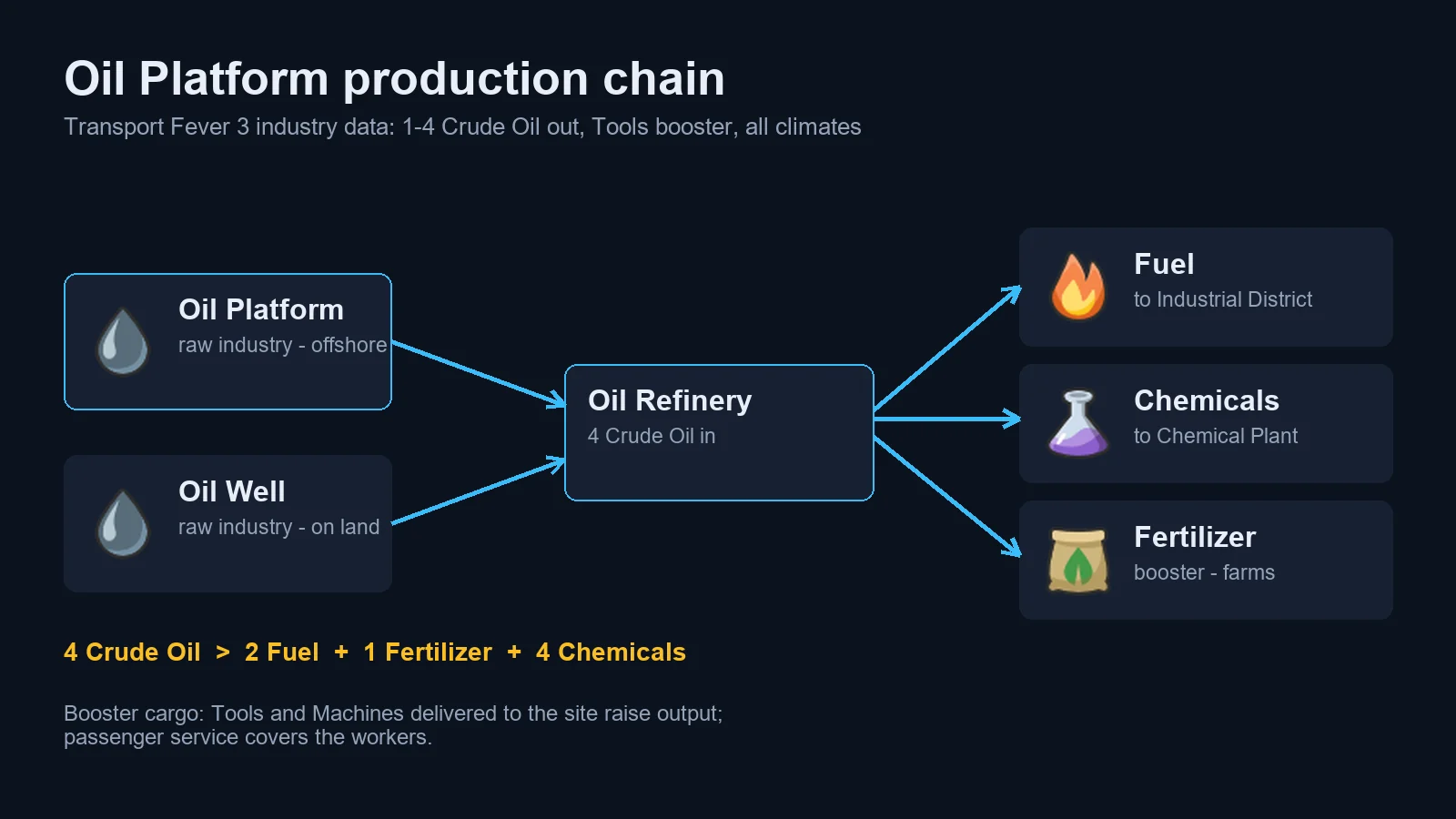
Crude Oil is a liquid raw material and has exactly one customer: the Oil Refinery. The refinery is the only industry in the game that consumes crude, and it splits every 4 units into three different outputs.
| Industry | Input | Output | Cargo class | Where the output goes |
|---|---|---|---|---|
| Oil Refinery | 4 Crude Oil | 2 Fuel | Liquid, end product | Industrial District |
| Oil Refinery | 4 Crude Oil | 4 Chemicals | Liquid, intermediate | Chemical Plant |
| Oil Refinery | 4 Crude Oil | 1 Fertilizer | Bulk, booster | Cotton Farm, Farm, Rubber Farm |
Fuel is the money-maker: it is an end product, so it is consumed by the Industrial District and never needs a further factory. Chemicals are the opposite, a mid-chain liquid that only the Chemical Plant wants, and that plant in turn produces something else. Fertilizer is the quiet third output, a booster cargo that farms consume to raise their own yield, which means a refinery is never a dead end even when the fuel market is saturated.
A working build order looks like this:
- Place the platform offshore, in water deep enough for the landing area, ideally close to the coast you intend to develop.
- Build a harbor landing area on that coast and make sure the pier reaches navigable water.
- Buy ships with liquid capacity and set the line to the platform and the shore terminal.
- Put an Oil Refinery within truck or rail reach of the shore terminal, then connect the refinery to the towns that want fuel.
- Add a Tools line into the platform once cash allows, because a booster cargo is a permanent multiplier on output.
- Watch the industry statistics screen for workload and shipment figures before you buy more ships; adding hulls to a full chain only burns fuel.
Official source: Transport Fever 3 manual: Industry statistics
Docking: the part that goes wrong
A harbor is not a station with a ship icon on it. It is a shore-only construction assembled from three parts: a landing area that sits in navigable water, a building and pier that straddle the shoreline, and a street connection on land. Landing areas come in two sizes, and the large ships in the later eras need the large landing area, which is the most common reason a beautiful oil terminal refuses to accept the tanker you just bought.
Harbors exist from 1900 and make no distinction between passenger and cargo berths, so one landing area can serve both if you configure the stops properly. Extras such as helipads attach to the harbor, which is how a coastal oil hub ends up with three transport modes on one footprint.
The practical checklist:
| Symptom | Likely cause | Fix |
|---|---|---|
| Ship will not load crude | Stop not configured for liquid cargo, or cargo filter left on default | Open the line, edit the stop, enable the liquid cargo and cap the load |
| Ship loads passengers instead | Default cargo settings were never touched | Set the line to crude oil only and lock the load |
| Ship cannot dock at all | Small landing area, large hull | Rebuild the landing area at the large size |
| Crude piles up at the platform | Storage cap reached, excess is destroyed | Add ships or a second refinery |
Official source: Transport Fever 3 manual: Stations and depots
Workers, Tools and the two boosters
Every industry in Transport Fever 3 reacts to two kinds of boosters, and the Oil Platform uses both.
The first is the passenger connection. A platform with a stop that brings workers in produces more, provided enough of them actually arrive. Too few workers and the industry throttles; the statistics window will name the missing requirement rather than leaving you guessing.
The second is booster cargo, which only raw industries accept. For the platform that cargo is Tools, produced by the Tool Factory and consumed on site. Tools are also demanded by the Clay Pit, the Coal Mine, the Fishing Grounds, the Quarry and the Sand Pit, so a single Tool Factory can feed an entire extractive region, and the platform is just one more customer on that route.
That is why the strongest offshore oil build in the mid game is not a pure oil line at all. It is a Tools loop that happens to end at a platform, with the crude run paying for the ships.
Why the platform appears in 1950
Offshore platforms are gated behind aviation. The community mod "Oil Rigs from 1950" exists for one stated reason: in the base game the offshore platform only appears from 1950 onward, when the first helicopters that can serve its helipad become available, and before that the entry is locked in the build menu. The mod pushes that date back so early-era players can build an oil economy without waiting for the jet age.
Two things follow. First, on a 1900 start you will spend fifty years on land-based Oil Wells, which produce up to 6 crude and take Machines as their booster instead of Tools. Second, prospecting matters: in the sandbox and tycoon tool sets, finding resources is a separate action from placing an industry, and an offshore field is only worth planning once you know the platform era is close.
Official source: Oil Rigs from 1950 on mod.io
The campaign mission that teaches it
Mission 5, Oil for the People, is set in the Ekofisk oil fields of Norway and is the only scripted scenario built around crude. Nils Eriksen, a local entrepreneur, is racing a foreign corporation for a drilling licence, and the star goals are all about speed: extract your first 1,000 units of oil before the competitor, deliver faster than Astrid, and end the scenario before Astrid reaches 750 or 500 units. The bonus medal, Rescue Lasse, is a separate objective entirely.
That mission is the cheapest place to learn platform logistics, because the map hands you the water, the refinery and the deadline. The campaign walkthrough covers the full mission order if you want the context before you start.
Common mistakes
- Treating the platform like a station: it is an industry, and it needs its own connection plus a downstream refinery.
- Ignoring the refinery's three outputs. Fuel pays, but Chemicals and Fertilizer keep other chains alive and stop the refinery from backing up.
- Buying the biggest tanker before checking the landing area size.
- Forgetting that output above the storage cap is destroyed. A platform with no ship is not "stockpiling for later".
- Building the harbor far from the refinery, then wondering why trucks cannot keep up with a 4-unit input per cycle.
Frequently Asked Questions
Does the Oil Platform need workers?
Yes. Like every industry it responds to a passenger connection, and a stop that delivers enough workers raises throughput. Too few workers and the platform throttles even if the crude line itself is healthy.
What is the difference between an Oil Platform and an Oil Well?
The platform is offshore and produces 1 to 4 crude with Tools as its booster; the well is on land and produces 1 to 6 crude with Machines as its booster. The platform unlocks in 1950, the well is available far earlier.
Can trucks collect crude from an oil platform?
No. The platform sits in navigable water, so the cargo comes ashore by ship through a harbor landing area. Trucks only take over once the crude is on land.
Why is my refinery only producing fuel?
It is not. Every cycle produces 2 Fuel, 4 Chemicals and 1 Fertilizer at once. If the chemicals and fertilizer have nowhere to go, the refinery's storage fills and production slows, which looks like a fuel-only refinery until you connect the missing customers.
Is the Oil Platform available in every climate?
Yes, all four climates have it. What changes is the map, not the industry: subarctic and tropical seeds make overland routes expensive, so the water link pays for itself sooner, while a dry desert map may never need a harbor at all if land-based wells can carry the refinery on their own.
The offshore picture only makes sense next to the rest of the economy, so pair this page with the offshore oil and fishing overview and the full production chain map. If your crude is moving but the platform is still underperforming, the industry closures and density guide explains why plots and service levels decide output.
More Transport Fever 3 Guides
Transport Fever 3 cargo stuck at the station? Demand, catchment, line setup and deadline checklist to get freight moving. Pre-launch.
How Transport Fever 3 pays for cargo: distance, speed, complexity, and on-time delivery windows that decide profit per load.
Transport Fever 3 city growth explained: 18 levels, XP, six ratings and hamlet-to-metropolis planning. Pre-launch guide.
TF3 hit PS5 and Xbox Series X|S on September 29, 2026 alongside PC: console prices, Game Pass status, save transfer, and why Xbox search fails.
Survive Transport Fever 3 hard mode: strict openers, loan discipline, and cashflow rules that keep a brutal start from ending early.
Helicopters in Transport Fever 3: oil platform helipads and the 1950 unlock, the Sikorsky S-76, where rotorcraft pay off and what the manual leaves out.
How money works in Transport Fever 3: delivery income, running costs, full loads, and the route habits that turn thin lines profitable.
Transport Fever 3 industries: density is a map slider, closures follow a 10-year rule and 730-day countdown, and boosters replace TF2 targets.